Two Rows or Three: How the 2026 Mazda CX-70 and CX-90 Differ
September 30 2026,
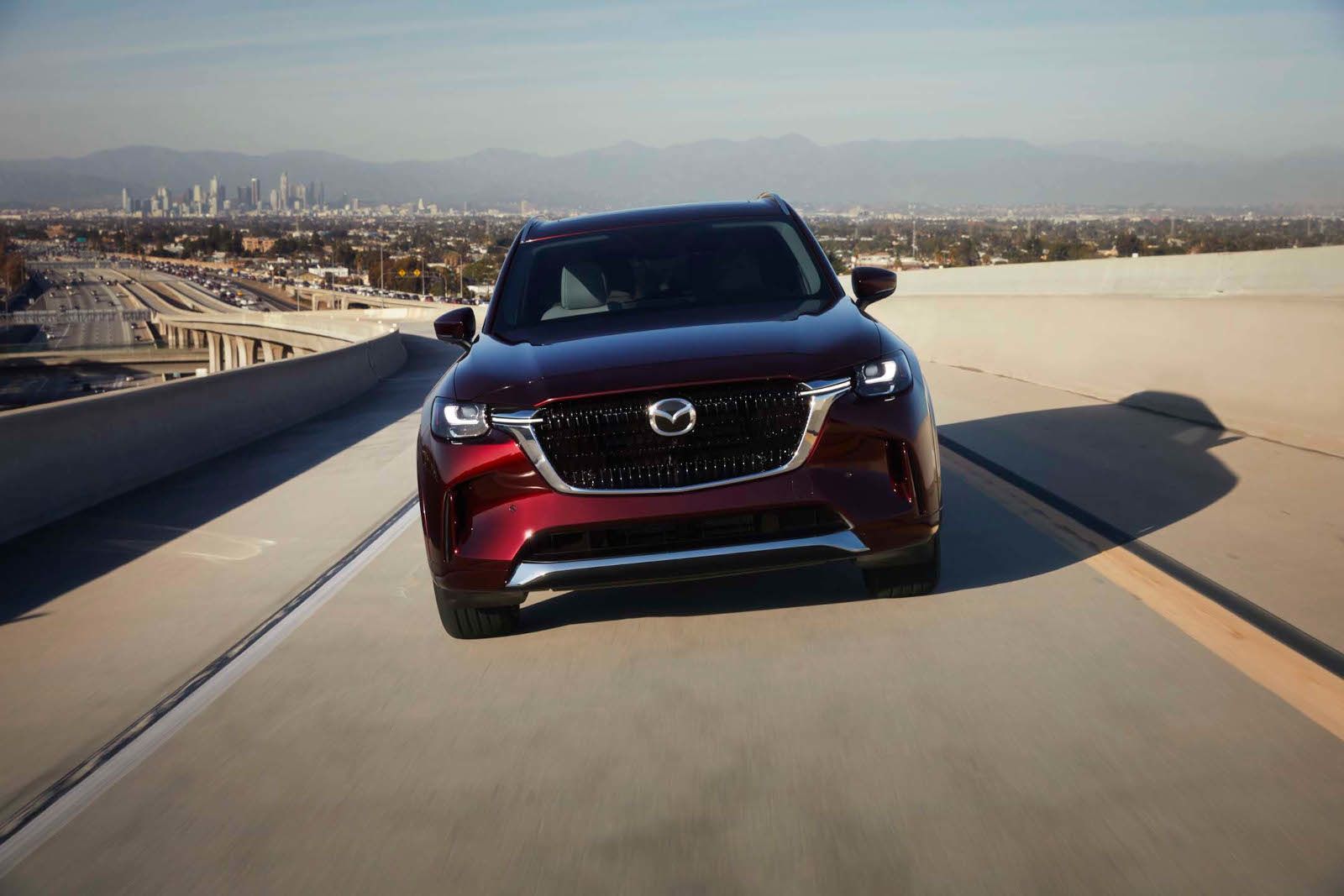
September brings school runs, weekend trips and a schedule that rarely sits still. For Ontario households, the choice between the 2026 Mazda CX-70 and CX-90 comes down to one question: does your family need a third row?
Both SUVs are 5,100 mm long on a 3,120 mm wheelbase. The CX-70 uses that footprint for two rows and five seats. The CX-90 fits a third row inside it. This guide shows what that changes and what stays the same.
CX-70 and CX-90 at a Glance
|
Spec |
CX-70 |
CX-90 |
|
Rows and seats |
2 rows, 5 seats |
3 rows, 7 or 8 seats |
|
Length / wheelbase |
5,100 mm / 3,120 mm |
5,100 mm / 3,120 mm |
|
Turning circle |
11.6 m |
11.6 m |
|
Cargo, behind rear seats |
1,131 L |
1,133 L |
|
Cargo, behind third row |
No third row |
423 L |
|
Cargo, behind front seats |
2,147 L |
2,101 L |
|
Mild-hybrid engine |
3.3 L inline-six turbo, 280 hp and 332 lb-ft (340 hp and 369 lb-ft on GT-P) |
3.3 L inline-six turbo, 280 hp and 332 lb-ft (340 hp and 369 lb-ft on GT-P) |
|
Plug-in hybrid engine |
2.5 L four-cylinder, 323 hp system output on 93 octane, 369 lb-ft |
2.5 L four-cylinder, 323 hp system output on 93 octane, 369 lb-ft |
|
Electric range |
51 km (GS-SC, GS-L SC); 43 km (GT, Signature) |
43 km |
|
Towing |
Mild hybrid GS-L: 5,000 lbs (2,268 kg); plug-in: 3,500 lbs (1,588 kg) |
Mild hybrid GS: 3,500 lbs (1,588 kg); mild hybrid GS-L: 5,000 lbs (2,268 kg) with Mazda Genuine Towing Accessories; plug-in: 3,500 lbs (1,588 kg) |
One Footprint, Two Seating Plans

The CX-70 seats five on every trim. The CX-90 seats seven or eight, depending on trim and second-row choice. Eight-seat versions use a 2-3-3 bench layout. Seven-seat versions use second-row captain’s chairs in a 2-2-3 layout.
On the mild-hybrid CX-90, captain’s chairs are an optional package on the GS-L, GT and GT-P, and standard on the Signature. The plug-in GT adds a third choice, a 2-3-2 bench layout. The eight-seat GS-L, GT and GT-P also add a one-touch switch for power third-row entry and exit.
The third row suits shorter rides. Its legroom is 773 mm, against 1,000 mm in the second row, and headroom is 936 mm. The CX-90 gives those seats four cup holders, dedicated air vents and child-seat anchors for both the second and third rows.
Second-row room is the same on both: 1,000 mm of legroom in the CX-90 and in the CX-70 PHEV Signature.
If your household is a couple or a family of four, the CX-70 gives every passenger a proper seat with no third row to plan around. If you carry six or seven people on a regular basis, the CX-90 is the model that solves it.
Cargo Space and What the Third Row Costs You
Behind the second row, the two SUVs sit a couple of litres apart. The CX-90 gives up almost nothing to add its extra seats. The difference shows up at the extremes.
With all three CX-90 rows in use, 423 L remains behind the third row, over a floor length of 527 mm. That handles groceries and soft bags, not a full camping load. Fold the third row and the floor stretches to 1,343 mm behind the second row.
The CX-70 has 46 L more maximum space than the CX-90, because there is no third row to fold. Its floor length behind the front seats is 2,245 mm on the PHEV Signature, against 2,438 mm for the CX-90. Both list 1,110 mm between the rear tire housings and a 1,106 mm liftgate opening width.
The CX-70 adds a luggage compartment storage box and remote-folding rear seats, which make loading easier when your hands are full. If most of your hauling is two-row luggage and sports gear, the CX-70 handles it without a spare row of seats.
Shared Engines, Different Ownership Choices
The two models draw from the same powertrain families. The mild-hybrid 3.3 L inline-six runs on regular fuel at its standard output. The GT-P and Signature in both lines step up to the high-output version. On the CX-90 GT-P, 340 hp arrives on 91-octane premium; on regular 87 it makes 319 hp.
Fuel use is nearly identical. The standard-output 3.3 L returns 9.3 L/100 km combined in the CX-70 GS-L and 9.4 L/100 km in the CX-90 GS. The plug-in models return 9.0 L/100 km (CX-70 GS-SC) and 9.2 L/100 km (CX-90).
The plug-in decision depends on your commute. The CX-70 GS-SC and GS-L SC offer 51 km of electric range, enough for a 25 km commute each way on battery alone. The CX-70 GT and Signature, and the CX-90, offer 43 km, which covers a 20 km commute each way. Every plug-in model has Mi-Drive with an EV mode.
Towing is where the trim you choose matters. Both plug-in lines tow 3,500 lbs (1,588 kg). On the mild hybrid, the CX-70 GS-L is rated at 5,000 lbs (2,268 kg). The CX-90 GS stays at 3,500 lbs (1,588 kg), while the GS-L adds Towing mode and the 5,000 lbs (2,268 kg) rating with Mazda Genuine Towing Accessories.
For a weekend trailer, a mild-hybrid CX-70 or a CX-90 GS-L or higher is the path. On the GT and above, Trailer Hitch View helps with hookups.
Trims and Features That Shape the Daily Drive
The entry points differ. The CX-70’s first mild-hybrid trim, the GS-L, already has a 12.3-inch display, wireless Apple CarPlay and Android Auto, a wireless phone charger, a power liftgate, a heated steering wheel and a power moonroof.
The CX-90 starts one step lower with the GS. It has a 10.25-inch display, wired CarPlay, cloth seats and a six-way manual driver’s seat. The CX-90 GS-L brings the 12.3-inch display, wireless connectivity, the heated steering wheel, a front wiper de-icer and Cruise & Traffic Support.
Both lines make the same jump at the GT: 360° View Monitor, Driver Monitoring, a 12-speaker Bose system, ventilated front seats, a panoramic moonroof and a windshield-projected Active Driving Display. The GT-P adds Emergency Lane Keeping with Blind Spot Assist in both.
Row-specific comfort separates them. The CX-90 GS-L and above carry USB-C charging ports for both the second and third rows, where the CX-70 offers two for the second row. The CX-90 GT and above heat the outboard second-row seats, and the plug-in Signature ventilates its second-row captain’s chairs.
At the top, the CX-70 Signature and the plug-in CX-90 Signature add 360° View Monitor with See-Through View, rear pedestrian detection and Turning Across Path.
Which Mazda Fits Your Household?
If you are a couple or a family of four, the CX-70 fits because its two rows use the full 5,100 mm body for passengers and cargo, with the largest maximum cargo figure of the pair. Its entry mild-hybrid trim is already well equipped, and the plug-in version reaches 51 km of electric range.
If you carpool, travel with grandparents or drive a full team, the CX-90 works because it seats seven or eight. You still get nearly the same cargo space behind the second row, and 423 L stays available behind the third row.
If you rarely need a third row but tow occasionally, the CX-70 GS-L carries the same 5,000 lbs (2,268 kg) rating as the CX-90 GS-L, with no extra seats to account for.
For a household that grows into a third row, the CX-90’s captain’s chairs or 2-3-3 bench give you the choice of a seven- or eight-seat layout.
Two Mazda SUVs, Two Household Sizes

The CX-70 and CX-90 share a 5,100 mm body, the same 3.3 L and 2.5 L powertrain families and nearly identical cargo space behind the rear seats. The third row, the tow-rating steps and the trim equipment decide which one suits your household.
Book a visit at Woodstock Mazda in Woodstock to see the seating layout that matches your household, and ask which trim carries the features you use every day.